
Rossmere Academy
Oracy
Our Oracy Vision
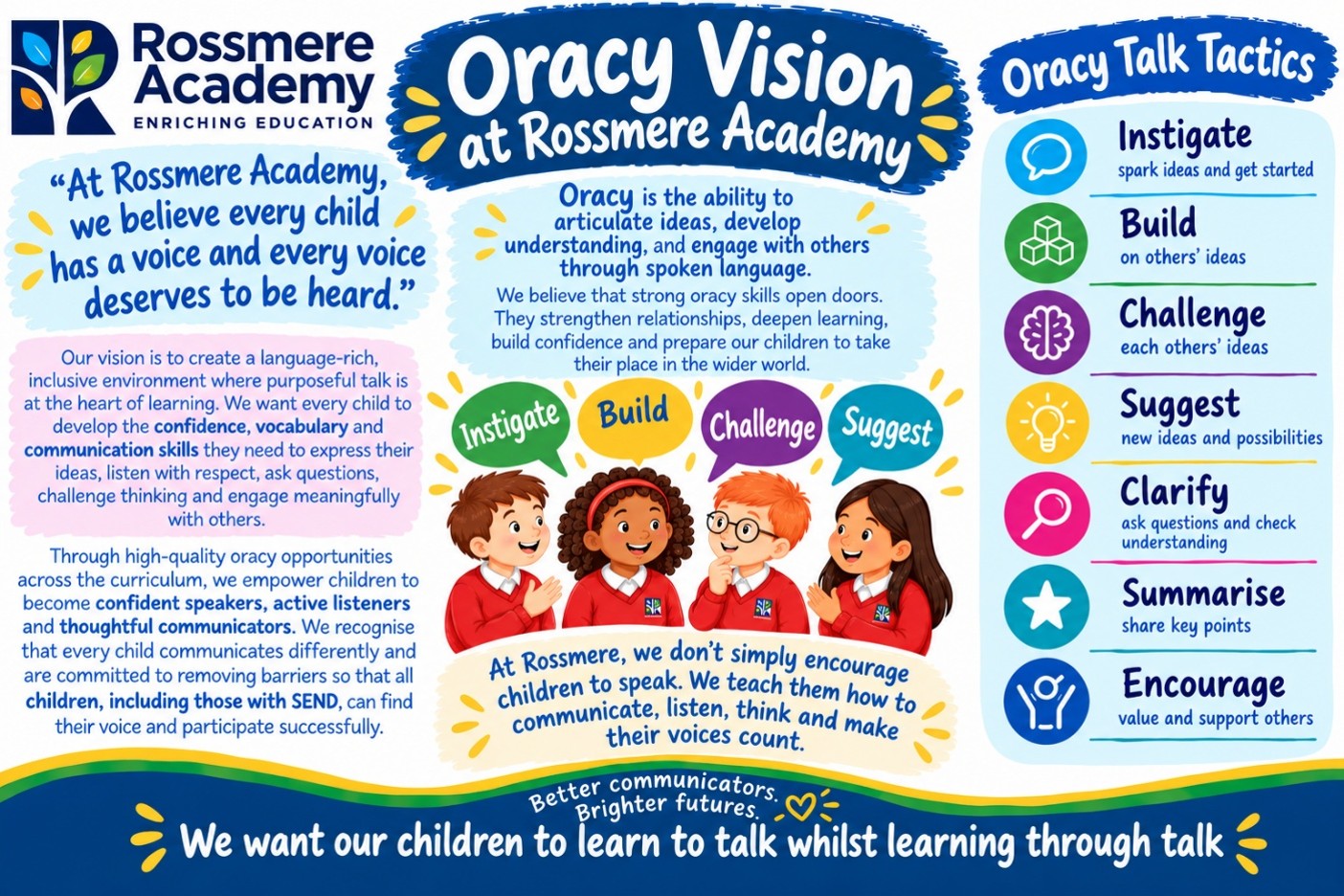
At Rossmere Academy, we believe every child has a voice, and every voice deserves to be heard.
We want every child to become a confident speaker, an active listener and a thoughtful communicator. We believe that spoken language is at the heart of learning and that developing strong communication skills helps children to build relationships, share ideas, deepen their understanding and prepare for the wider world.
Our vision is to create a language-rich, inclusive environment where purposeful talk is part of everyday learning. We want our children to develop the confidence, vocabulary and communication skills they need to express their ideas, listen respectfully, ask questions, challenge thinking and engage meaningfully with others.
We recognise that every child communicates differently. We are committed to providing opportunities for all children, including those with special educational needs and disabilities (SEND), to develop their communication skills, overcome barriers and participate successfully in learning.
At Rossmere, we don't simply encourage children to speak. We teach them how to communicate, listen, think and make their voices count.
What is Oracy?
Oracy is the ability to articulate ideas, develop understanding and engage with others through spoken language.
Put simply, oracy is learning to talk and learning through talk. Children learn how to express themselves clearly, explain their thinking, listen to different viewpoints and work collaboratively with others.
At Rossmere Academy, we believe that strong oracy skills open doors. They strengthen relationships, deepen learning, build confidence and prepare our children to take their place in the wider world.
Why is Oracy Important?
Developing oracy skills helps children to:
- Build confidence – feel comfortable sharing their thoughts, ideas and opinions.
- Develop vocabulary – learn and use new words to explain their thinking.
- Become active listeners – listen carefully and show respect for the views of others.
- Deepen their learning – explain their understanding, ask questions and explore new ideas.
- Think critically – consider different perspectives and challenge ideas respectfully.
- Work collaboratively – take turns, build on others' contributions and solve problems together.
- Prepare for the future – develop the communication skills they will need in school, in relationships and in the world of work.
The Voice 21 Oracy Framework
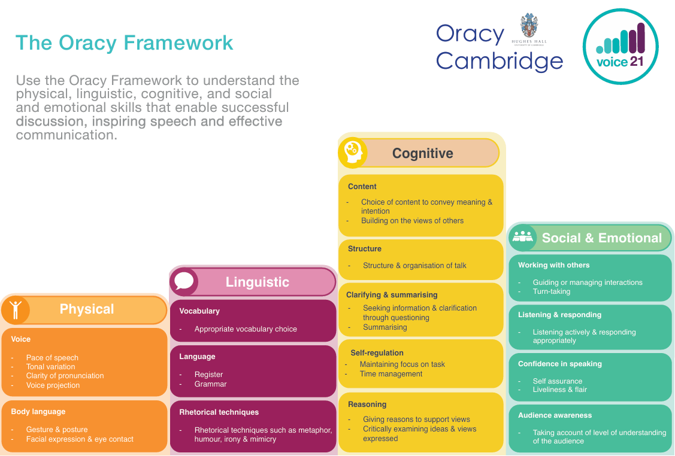
At Rossmere Academy, our approach to oracy is informed by the Voice 21 Oracy Framework, developed by Voice 21 in partnership with Oracy Cambridge. The framework helps us understand and explicitly teach the skills children need to become effective speakers, listeners and communicators.
The framework is organised into four interconnected strands. Together, these help children develop the skills they need to communicate confidently and effectively in different situations.
1. Physical – How we speak
Children learn to use their voice, tone, pace, volume, facial expressions, gestures and body language to communicate effectively.
2. Linguistic – The language we use
Children develop their vocabulary and learn to choose appropriate words and language to express their ideas clearly for different purposes and audiences.
3. Cognitive – How we organise our thinking
Children learn to explain their reasoning, ask questions, clarify and summarise information, consider different viewpoints and build on the ideas of others.
4. Social and Emotional – How we communicate with others
Children develop confidence when speaking, listen actively, take turns, work collaboratively and show respect for the ideas and feelings of others.
These four strands reflect the Voice 21 Oracy Framework.
Our Journey at Rossmere
When we began our oracy journey, we introduced the framework one strand at a time. We started with the Social and Emotional strand, as we felt this was an area in which all staff could contribute, from Early Years through to Year 6.
We wanted to establish a positive culture where children feel safe to share their ideas, confident to contribute and respectful of one another. Developing these foundations has helped us build a shared understanding of what effective talk looks like across our school.
We continue to develop our approach by embedding oracy into everyday teaching and learning. Our Discussion Guidelines, Giving Proof of Listening resources and Oracy Talk Tactics support children to practise these skills regularly across the curriculum.
The four strands are interconnected, and children develop them together as they take part in purposeful conversations, explore new ideas and learn through talk.
You can find out more about the framework on the official Voice 21 website.
The Resources We Use to Support Oracy Every Day
At Rossmere Academy, we believe that developing strong communication skills is an essential part of everyday learning. We use a range of shared resources, visual prompts and strategies to help children become confident speakers, active listeners and thoughtful communicators.
These resources provide children with clear reminders of how to take part in purposeful conversations, work collaboratively and show respect for the ideas of others. By using a consistent approach across the school, we help children develop the skills and confidence to contribute meaningfully to discussions in every classroom.
Giving Proof of Listening
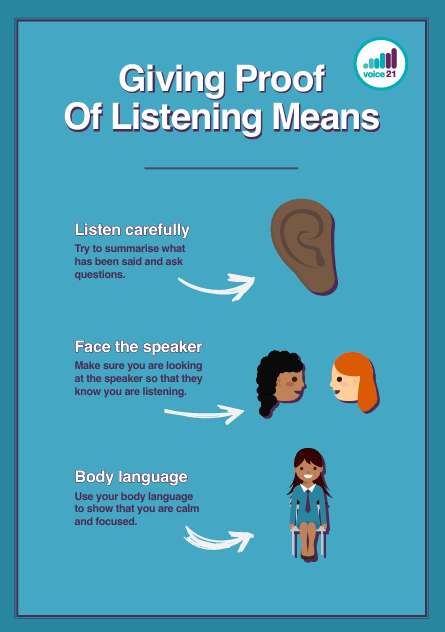
We teach children that listening is an active skill. Our Giving Proof of Listening poster provides practical reminders to help children show that they are listening to others.
Children are encouraged to:
- Listen carefully – summarise what has been said and ask questions.
- Face the speaker – show the speaker that they have their attention.
- Use positive body language – show that they are calm and focused.
These reminders help children develop respectful listening habits and understand that effective communication involves both speaking and listening.
Discussion Guidelines
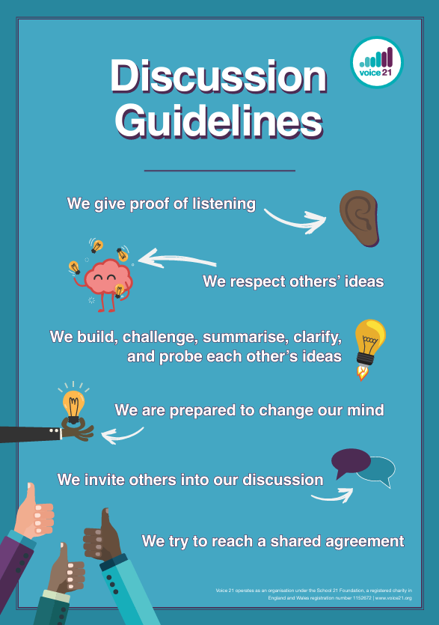
Our Discussion Guidelines help children understand how to participate positively and productively in group discussions. They encourage children to:
- Give proof of listening.
- Respect other people's ideas.
- Build on, challenge, summarise, clarify and probe each other's ideas.
- Be prepared to change their minds.
- Invite others to join the discussion.
- Try to reach a shared agreement.
These guidelines help children understand that a good discussion is not just about sharing their own ideas; it is also about listening, responding thoughtfully and learning from others.
Our Oracy Talk Tactics
At Rossmere, we use seven Oracy Talk Tactics to help children develop purposeful, meaningful conversations. These tactics give children practical ways to contribute to discussions and become more confident communicators.
Instigate - Spark ideas, start conversations and get discussions going.
Build - Build on other people's ideas and add to what has already been said.
Challenge - Challenge each other's ideas respectfully and give reasons for our opinions.
Suggest - Share new ideas, offer possibilities and think creatively.
Clarify - Ask questions, check understanding and explain ideas more clearly.
Summarise - Identify and share the key points from a discussion.
Encourage - Value other people's contributions and support everyone to take part.
The Talk Tactics help children know how to contribute to conversations and move discussions forward.
Children are encouraged to use these tactics when working with partners, participating in group activities, exploring ideas and explaining their thinking across the curriculum.
Working Together to Develop Confident Communicators
By embedding these resources into everyday classroom practice, we aim to make oracy a natural part of learning at Rossmere Academy. Children are supported to develop the confidence to share their ideas, the skills to listen and respond respectfully, and the ability to learn with and from one another.
Parents and carers can support this approach at home by encouraging children to explain their thinking, ask questions, listen to different opinions and build on what others have said.
We want our children to learn to talk whilst learning through talk.
Better communicators. Brighter futures.
How Do We Develop Oracy at Rossmere?
We believe that oracy is everyone's responsibility and that every child should have opportunities to develop their communication skills throughout the school day.
Our journey began by introducing the Voice 21 Oracy Framework one strand at a time. We started with the Social and Emotional strand, as we recognised that creating a supportive environment where children feel safe, valued and confident to contribute is essential for effective communication. This provided a foundation for all staff to contribute to our oracy journey, from Early Years through to Year 6.
We continue to develop oracy across the curriculum through opportunities such as:
- Partner talk and small-group discussions.
- Sharing ideas, explaining answers and reasoning aloud.
- Asking and answering questions.
- Learning new vocabulary and using it in context.
- Listening to different opinions and responding thoughtfully.
- Working collaboratively to solve problems.
- Developing confidence when speaking to larger groups.
Our Oracy Talk Tactics help children understand how to take an active role in conversations, while our shared vision provides a consistent approach across the school.
How Can Parents and Carers Support Oracy at Home?
You play an important role in helping your child develop their communication skills. Everyday conversations provide valuable opportunities for children to practise speaking, listening and expressing themselves.
Here are some simple ways to support your child at home:
Talk together every day
Chat about your child's day, a book they have read, something they have noticed or an activity they have enjoyed. Give them time to think and respond.
Ask open-ended questions
Instead of questions that only need a yes or no answer, try asking, “What do you think might happen next?”, “Why do you think that?” or “How could we solve this?”
Encourage listening and turn-taking
Model listening carefully, taking turns to speak and showing interest in what others have to say.
Explore new words
Talk about new words during reading, cooking, playing or visiting new places. Encourage your child to explain what words mean and try them out in their own sentences.
Play games that encourage talk
Board games, imaginative play, storytelling and describing objects can all help children practise explaining, questioning, suggesting and building on ideas.
Most importantly, show your child that their ideas matter. Give them time to speak, celebrate their contributions and encourage them to share their thoughts without worrying about always getting things right.
Our Shared Ambition
At Rossmere Academy, we want every child to feel that their voice matters. Through purposeful talk, active listening and meaningful opportunities to communicate, we aim to nurture children who are confident expressing themselves, respectful of others and ready to engage with the world around them.
We want our children to learn to talk whilst learning through talk.
Better communicators. Brighter futures.